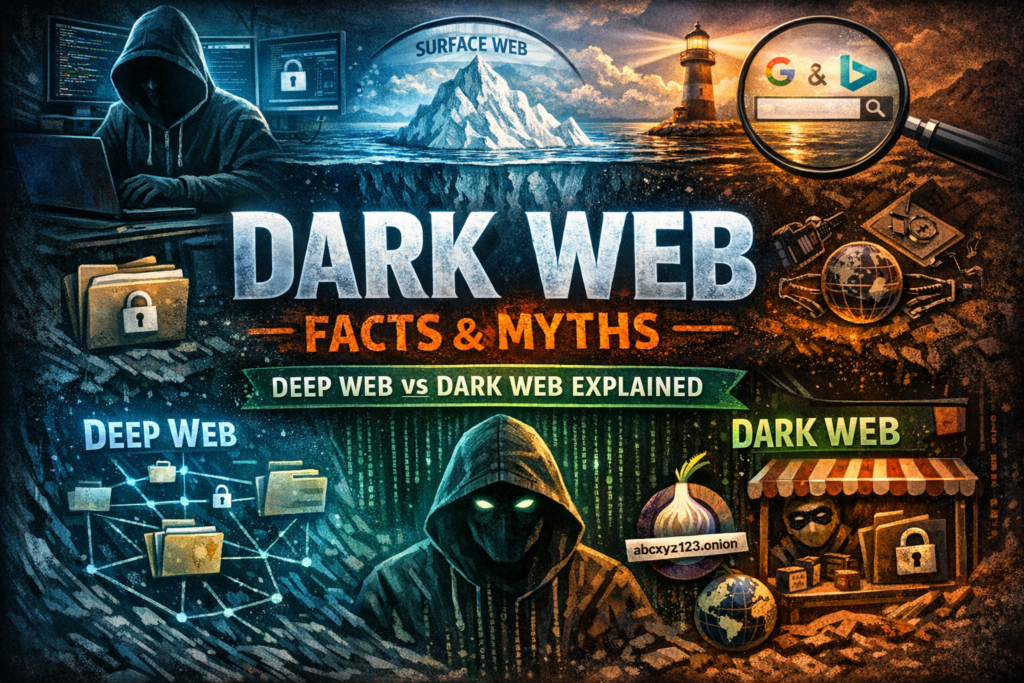
“Dark Web” is one of those phrases that instantly triggers the same mental image: hoodies, hackers, and shady marketplaces. It’s the internet equivalent of a horror movie trailer.
Reality is less cinematic — and far more useful.
🚀 Follow Me on X – New Account
My previous X account @AngrySysOps was suspended.
I am continuing the same tech, cybersecurity, and engineering discussions under a new handle.
Follow @TheTechWorldPod on X for daily insights, threads, and podcast updates.
This article is here to do one thing properly: define terms and kill the most common myths. Because if you mix up Deep Web and Dark Web, everything else you “know” about the topic ends up built on sand.
The Internet Has Layers (Surface, Deep, Dark)
1) Surface Web (what most people call “the internet”)
This is the part that:
- Google/Bing can index
- you can access with a normal browser
- lives on regular domains and public sites
News sites, blogs, public documentation, product pages — that’s surface web.
2) Deep Web (private / non-indexed)
The Deep Web is everything search engines don’t index because it’s not meant to be public, for example:
- anything behind login (banking, email, social admin panels)
- internal tools (Jira, Confluence, vCenter, CRM)
- paywalled content
- private company portals and intranets
- database-driven pages behind forms
Deep Web ≠ shady.
It’s mostly just “stuff that belongs to someone,” not “stuff from a cybercrime documentary.”
3) Dark Web (intentionally hidden services)
The Dark Web is a subset of the deep web — but with a key difference:
It’s not just “not indexed.”
It’s intentionally designed to be accessed via special networks, most commonly Tor.
That’s where you’ll see sites using addresses ending in:
🚀 Follow Me on X – New Account
My previous X account @AngrySysOps was suspended.
I am continuing the same tech, cybersecurity, and engineering discussions under a new handle.
Follow @TheTechWorldPod on X for daily insights, threads, and podcast updates.
.onion
Dark Web = hidden services on overlay networks (like Tor).
Why Do .onion URLs Look So Weird?
Because they’re not brand names. They’re closer to cryptographic identifiers.
On the regular internet:
- domain names are registered and resolved via DNS
- trust is handled via certificates + infrastructure + registrars
On Tor:
.onionservices use addresses that are effectively self-authenticating- no classic DNS
- routing happens through the Tor network
That’s why a legit onion address often looks like random characters — it’s not marketing, it’s math.
Dark Web Myths vs Facts
Myth #1: “The dark web is only illegal stuff”
Fact: The dark web is a technology layer, not a crime category.
Yes, illegal markets and fraud exist there. But so do:
- privacy communities and research forums
- mirrors of legitimate sites (especially for censorship resistance)
- whistleblowing and journalist dropboxes
- resources for people living under surveillance or censorship
The tool isn’t automatically evil. The use-case can be.
Myth #2: “Using Tor is illegal”
Fact: In most places, using Tor isn’t illegal.
What matters is what you do with it — not the fact you used privacy tech.
Myth #3: “Tor makes you invisible”
Fact: Tor improves privacy, but it doesn’t make you magically untraceable.
People deanonymize themselves all the time through:
- logging into personal accounts
- installing browser add-ons
- downloading documents and opening them outside a controlled environment
- clicking the wrong links (phishing)
- sloppy OPSEC
Tor reduces exposure. It doesn’t remove consequences.
Myth #4: “The dark web is one single network”
Fact: “Dark web” is an umbrella term.
Tor is the most well-known, but there are other overlay networks. Tor is just the one most people mean when they say “dark web.”
Myth #5: “Everything there is private and safer”
Fact: Dark web environments can be more private, but they can also be more hostile:
- more scams, clones, and impersonation
- weaker identity signals and reputation systems
- worse UX (by design)
- higher reliance on user hygiene
If you don’t verify what you’re visiting, you’re the easiest target in the room.
Why Does the Dark Web Exist at All?
Because some people have legitimate reasons to avoid:
- censorship
- mass surveillance
- network-level tracking
- targeted harassment
Real-world use cases include:
- access to information in restricted countries
- anonymous publishing
- journalism and whistleblowing
- safe communications under high risk
- read-only mirrors of sites to ensure availability
It’s not a “good vs evil” zone. It’s an “assume you’re being watched” zone.
Deep Web vs Dark Web (clean summary)
Deep Web
- Not indexed
- Usually behind login / private access
- Works in normal browsers
Dark Web
- Requires overlay network software (e.g., Tor Browser)
- Uses
.onionservices - Built for privacy / anonymity and censorship resistance
If you need a password: probably deep web.
If you need Tor: you’re entering dark web.
Next in the Series: How to Access the Dark Web + My Site Mirror
In the next article, we’ll go practical:
- How to access Tor safely (without doing anything stupid)
- How to verify you’re not landing on clones/scams
- How to navigate
.onionsites without getting baited - And how to visit my own read-only mirror site on Tor
My onion mirror: angrysysops.onion
(If you paste it in your reply, I’ll drop it in cleanly and add a short “how to verify this is the real AngrySysOps mirror” checklist.)
🚀 Follow Me on X – New Account
My previous X account @AngrySysOps was suspended.
I am continuing the same tech, cybersecurity, and engineering discussions under a new handle.
Follow @TheTechWorldPod on X for daily insights, threads, and podcast updates.