If you work with VMware Cloud Foundation, you already know the problem.
Standing up a proper lab is rarely simple. It eats hardware, time, network prep, and patience. Even when you get it running, repeating the same build for testing, demos, validation, or training can turn into a project of its own.
That is exactly where Holodeck comes in.
Holodeck is a toolkit and validated reference architecture built to automate and standardize nested VMware Cloud Foundation lab deployments on a single ESX host or a vSphere cluster. In plain English, it gives you a faster, cleaner, more repeatable way to spin up self-contained VCF environments for testing and training without building half a datacenter first.
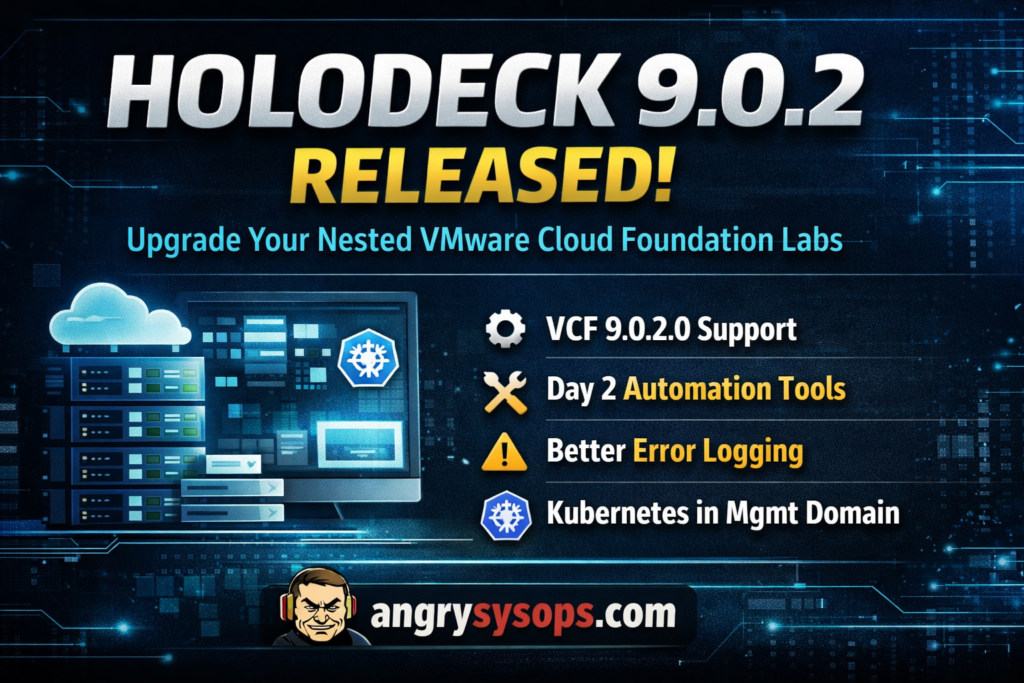
Now Holodeck 9.0.2 has reached general availability, and this maintenance release brings more than just bug fixes. It expands VCF version support, improves Day 2 operations, tightens reliability, and makes troubleshooting far less painful. According to the official release notes, Holodeck 9.0.2 supports VCF 9.0.2.0, 9.0.1.0, 9.0.0.0, plus VCF 5.2, 5.2.1, and 5.2.2.
🚀 Follow Me on X – New Account
My previous X account @AngrySysOps was suspended.
I am continuing the same tech, cybersecurity, and engineering discussions under a new handle.
Follow @TheTechWorldPod on X for daily insights, threads, and podcast updates.
So, what is Holodeck really?
Holodeck is not just “some scripts.”
It is a packaged way to deploy nested VCF labs with built-in supporting services and automation. The official documentation highlights several core advantages: reduced hardware requirements, self-contained services, isolated networking, environment isolation, and near hands-off repeatable deployment. Holodeck can include services such as DNS, DHCP, NTP, AD, and certificate services inside the environment, which means you do not need to depend on external lab infrastructure for every single test cycle.
That matters because most people do not have the luxury of dedicating a full production-like hardware stack just to validate a feature, rehearse an upgrade, test a design, or run internal training.
Holodeck gives teams a way to learn VCF, break VCF, fix VCF, and understand VCF in a controlled nested environment before touching anything that pays the bills.
What is new in Holodeck 9.0.2?
This release builds on Holodeck 9.0 and 9.0.1 and sharpens the platform in a few important areas.
1. Support for VCF 9.0.2.0
The headline item is straightforward: Holodeck 9.0.2 adds support for VCF 9.0.2.0. The release notes also note that VCF Installer 9.0.2.0 can be used to deploy VCF 9.0.0.0, 9.0.1.0, and 9.0.2.0 environments, which gives labs more flexibility when validating different versions side by side.
For engineers, architects, and platform teams, that means a better way to rehearse upgrades, compare behavior across versions, and validate operational workflows without guessing.
2. Supervisor support in the management domain
Holodeck 9.0.2 introduces support for deploying Supervisor in the management domain through the new -DeploySupervisorMgmtDomain parameter. The older -DeploySupervisor parameter has also been renamed to -DeploySupervisorWldDomain for clarity.
That is a useful change because it makes Kubernetes-related testing in VCF labs more flexible and more explicit. If your team is exploring platform services, Kubernetes integration, or management-domain design choices, this is one of the more practical additions in the release.
3. Better Day 2 operations
One of the most meaningful changes is the new Update-HoloDeckInstance cmdlet. The official release notes position it as the dedicated path for post-deployment operations, replacing the previous interactive approach for those workflows. It supports adding clusters to VCF instances and deploying a VCF Automation All Apps Org, using parameters such as -Site, -VIDomain, and operation-specific flags for tighter control.
This is a big deal because Day 2 is where many lab tools start to feel clumsy.
Deploying the initial environment is only half the story. Real testing usually means expanding, modifying, validating, and breaking things after the first deployment. A cleaner operational model for Day 2 makes Holodeck more useful for actual platform engineering work, not just one-time demo builds.
4. Improved reliability and easier troubleshooting
This is the part admins usually care about most.
Holodeck 9.0.2 adds dedicated error logging under /holodeck-runtime/logs/, with stack traces, exception types, and detailed error records. That should make troubleshooting far less annoying when something fails halfway through a nested build.
The release also improves HoloRouter behavior by splitting DNSMASQ into separate DNS and DHCP pods, which the release notes describe as a reliability and scalability improvement. On top of that, Holodeck now automates HTTPS certificate trust establishment between the VCF Installer and the offline depot, including self-signed certificate import, and it adds retry logic for failed bundle downloads.
That may not sound glamorous, but it is exactly the kind of plumbing that decides whether a lab feels smooth or miserable.
5. Cmdlet and operational improvements
There are a few smaller but useful changes as well.
New-HoloDeckInstance now requires an InstanceID, which helps with cleaner instance management. Get-HoloDeckInstance can retrieve details about nested components deployed through New-HoloDeckInstance. Start-HoloDeckInstance and Stop-HoloDeckInstance were also updated to better handle more complex deployment types, including correct power-off sequencing. There is also a new Get-HolodeckServiceIPPools cmdlet for displaying IP pool allocations used by Holodeck services.
That last one will be especially welcome to anyone who has ever stared at nested lab networking and wondered which service consumed what.
Bug fixes and quality improvements
Holodeck 9.0.2 also addresses multiple issues reported by the community. The release notes call out fixes and workarounds for NSX-related deployment issues, offline depot authentication and proxy handling, state management issues for Day 2 operations, DNSMASQ and service-definition improvements, and stricter validation around CIDR sizing and deployment pre-checks.
That is worth noting because lab tooling lives or dies on stability. Fancy automation is great, but if it cannot reliably survive real-world edge cases, people stop trusting it.
The good sign here is that Holodeck appears to be maturing through active community feedback and iterative hardening.
Why Holodeck matters
This is the bigger picture.
Modern infrastructure teams need a way to test faster without burning production time or demanding ridiculous lab budgets. Holodeck helps by turning nested VCF into something far more practical. Official documentation states that a typical VCF 9.0 standard architecture lab with a four-node management domain and a three-node VI workload domain can run nested with roughly 24 CPU cores, 325 GB of memory, and 1.1 TB of disk, depending on the environment.
That does not make it “small,” but it does make VCF labs far more accessible than trying to recreate everything with dedicated physical infrastructure.
For teams doing proof-of-concepts, platform training, operational runbooks, design validation, or upgrade rehearsals, that matters a lot.
Holodeck is useful because it lowers the barrier to actually learning and testing VCF properly.
What you need to get started
The official downloads page lists the required components for Holodeck 9.0.2: the HoloRouter OVA, the relevant VCF binaries from the Broadcom Support Portal, and optionally the Offline Depot OVA for air-gapped or restricted environments. The documentation also notes that Broadcom account entitlement is required for the VCF downloads.
Final thoughts
Holodeck 9.0.2 is the kind of release that does not need hype to be useful.
It expands version support, improves Kubernetes-related deployment options, introduces a cleaner model for Day 2 operations, and puts real effort into reliability and troubleshooting. That combination makes it more valuable not only for demos and training, but for serious hands-on validation work around VMware Cloud Foundation.
If you are working through your VCF journey and you need a repeatable nested lab that does not turn into a weekend-long science experiment, Holodeck is worth a serious look.
Useful links
Documentation: VMware Holodeck docs
Downloads: Holodeck downloads page
Release Notes: Holodeck 9.0.2 release notes
Credits
The project contributors listed in the release information are Ben Sier, Jatin Purohit, Dhruv Tyagi, Nikhil M Kulkarni, Tom Stephens, and Kevin Tebear.
🚀 Follow Me on X – New Account
My previous X account @AngrySysOps was suspended.
I am continuing the same tech, cybersecurity, and engineering discussions under a new handle.
Follow @TheTechWorldPod on X for daily insights, threads, and podcast updates.