VCF 9.1 Has Landed
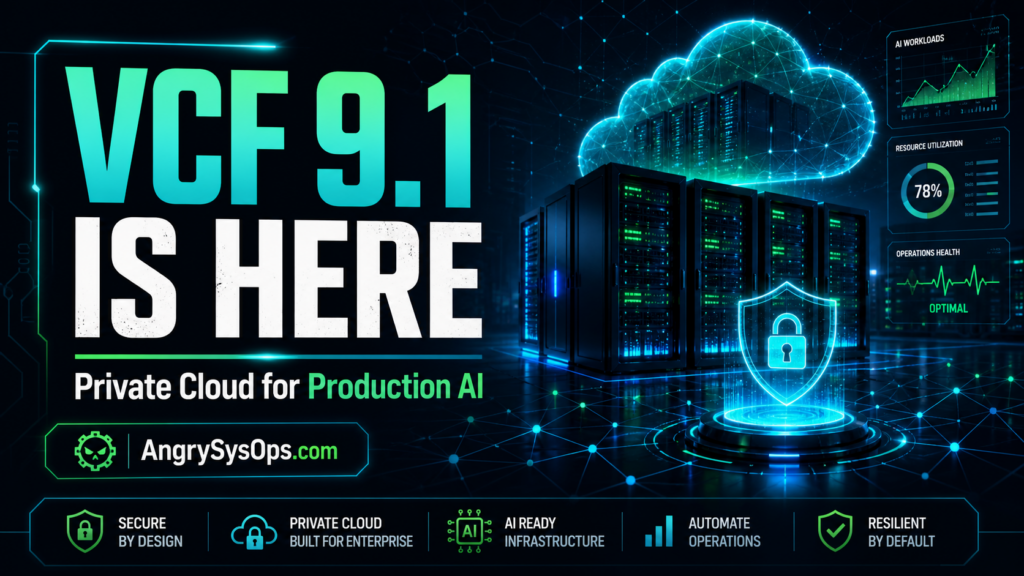
Broadcom has announced VMware Cloud Foundation 9.1, and the message is very clear:
Private cloud is not dead.
In fact, Broadcom is positioning VCF 9.1 as the platform enterprises should use when AI stops being a lab experiment and becomes something that needs governance, security, cost control and actual operational ownership.
You know, the boring stuff that suddenly becomes very important when the proof of concept becomes production and the invoice arrives.
The official announcement describes VCF 9.1 as a secure and cost-effective infrastructure platform for production AI workloads, supporting mixed compute infrastructure across AMD, Intel and NVIDIA. Broadcom is aiming this release at inference, agentic AI, Kubernetes workloads, traditional VMs and enterprise private cloud environments that need to run under real security and compliance constraints.
And yes, before every VMware admin asks the same question:
This is not just “AI marketing paint.” There are some real infrastructure changes here worth looking at.
The Big Message: Production AI Belongs Close To The Data
Broadcom is leaning hard into one idea:
Enterprises want AI, but they do not necessarily want all their AI workloads living in public cloud.
That makes sense.
🚀 Follow Me on X – New Account
My previous X account @AngrySysOps was suspended.
I am continuing the same tech, cybersecurity, and engineering discussions under a new handle.
Follow @TheTechWorldPod on X for daily insights, threads, and podcast updates.
AI workloads are expensive. Data movement is expensive. Governance is hard. Security teams get nervous. Legal teams get very nervous. And somewhere in the background, finance is wondering why the cloud bill suddenly looks like a small national budget.
Broadcom’s announcement references its Private Cloud Outlook 2026 preview, saying that 56% of surveyed organizations are running or planning to run production inferencing in a private cloud, while public cloud use for production inference was reported at 41%, down 15% year over year. It also says 62% of IT leaders are very or extremely concerned about generative AI infrastructure costs, and 36% say AI is driving new requirements around data protection, privacy, security controls and risk management.
That is the entire sales pitch for VCF 9.1 in one sentence:
Run AI where you already have control, governance and infrastructure ownership.
And honestly, that is not a bad argument.
What Broadcom Claims VCF 9.1 Improves
The headline numbers are interesting, but they should be read like any vendor benchmark: useful, but not automatically guaranteed in your environment.
Broadcom claims VCF 9.1 can deliver:
- Up to 40% reduction in server costs through intelligent memory tiering
- Up to 39% lower storage TCO through enhanced compression and deduplication
- Up to 46% reduction in Kubernetes operational costs
- 4x faster cluster upgrades
- 2x increased fleet capacity
The important footnote: Broadcom says these numbers are based on internal estimates or test results from April 2026, and some advanced services are sold separately.
Translation:
Nice numbers.
Do not paste them into your business case without checking the assumptions.
Classic infrastructure rule:
Vendor benchmark ≠ your production environment.
Fleet Management Gets More Serious
One of the more interesting parts for large VMware shops is scale.
Broadcom says VCF 9.1 doubles management capacity to 5,000 hosts and delivers faster cluster upgrades across distributed and air-gapped environments.
That matters.
For smaller environments, this might just sound like a big number. For enterprise estates with multiple sites, management domains, workload domains, security boundaries, satellite locations and change windows that require a meeting before the meeting, this is important.
Fleet-level operations are where VCF either becomes valuable or becomes just another management layer people are afraid to touch.
If 9.1 genuinely improves lifecycle operations, upgrade velocity and fleet visibility, that is a real day-two operations improvement.
Because nobody wants a private cloud platform that looks great in a reference architecture but turns every patching window into a hostage situation.
Kubernetes, VKS And The “One Platform” Story
VCF 9.1 is also continuing the push toward a unified platform for:
- Traditional VMs
- Kubernetes workloads
- AI inference
- Agentic AI applications
- Containerized services
Broadcom says VCF 9.1 delivers 2.6x increased Kubernetes cluster scale, 70% faster deployments and 75% shorter upgrade windows compared to preview versions.
This matters because VMware’s Kubernetes story has often suffered from one problem:
🚀 Follow Me on X – New Account
My previous X account @AngrySysOps was suspended.
I am continuing the same tech, cybersecurity, and engineering discussions under a new handle.
Follow @TheTechWorldPod on X for daily insights, threads, and podcast updates.
People liked the idea.
The implementation and operations model were where the questions started.
With VCF 9.x, Broadcom clearly wants vSphere Kubernetes Service to be treated as a first-class part of the private cloud platform, not an optional science project bolted onto vSphere.
That is the right direction.
Most enterprises are not going to throw away their VM estate overnight. They need a platform where VMs and containers can coexist without creating two completely separate operational universes.
Private AI Services: More Than Just GPUs
Another major part of the announcement is VCF Private AI Services.
Broadcom says VCF Private AI Services in VCF 9.1 adds capabilities around secure model integration, Google Workspace support, DirectPath GPU enablement, support for NVIDIA Blackwell GPUs, AI observability dashboards and CPU-based inferencing using Llama.cpp.
A few items stand out.
First, Model Context Protocol support with governance. That is interesting because MCP is becoming a common way to connect AI assistants to internal systems and tools. Broadcom says this allows integration with repositories and tools such as Oracle, Microsoft SQL Server, ServiceNow, GitHub, Slack and PostgreSQL without building custom connectors.
Second, support for Google Workspace documents means Google Docs, Sheets and Slides can be used without exporting them into PDFs first. That sounds small, but anyone who has tried to operationalize enterprise knowledge retrieval knows document handling becomes painful very quickly.
Third, CPU-based inferencing is worth watching. Not every AI workload needs a monster GPU farm. For smaller models, testing, proof-of-concepts or lower-intensity inference workloads, CPU-based inferencing can reduce cost and complexity.
That is the part I like.
Not every company needs to pretend it is building OpenAI in the basement.
Sometimes you just need useful internal AI running close to your data without lighting the budget on fire.
Security: This Is Where Private Cloud Still Has A Strong Argument
Security is a big part of the VCF 9.1 positioning.
Broadcom is talking about:
- Zero-trust segmentation
- Ransomware recovery
- Continuous compliance
- Distributed IDS/IPS for Kubernetes workloads
- Self-service security automation
- CrowdStrike Falcon Endpoint Security integration for recovery workflows
The announcement says VCF 9.1 includes isolated recovery environments and validation tooling, including new CrowdStrike Falcon Endpoint Security support, aimed at protecting AI models and training data during ransomware recovery scenarios.
That is important.
AI systems are not just compute workloads. They are connected to data, intellectual property, documents, customer information, internal systems and decision workflows.
If compromised, the issue is not only “restore the VM.”
It becomes:
- Can we trust the model?
- Can we trust the data?
- Can we trust the recovered environment?
- Was sensitive data moved?
- Was the AI system manipulated?
- Did we restore cleanly or just rehydrate the problem?
This is where infrastructure people, security teams and platform teams need to work together. AI does not remove operational discipline. It increases the blast radius when discipline is missing.
Networking And Hardware Choice
VCF 9.1 also brings more focus to high-performance AI networking.
Broadcom says the platform supports NVIDIA ConnectX-7 NICs and NVIDIA BlueField-3 with Enhanced DirectPath I/O, enabling high-speed multi-host AI model training and data transfer.
There is also mention of standards-based EVPN and VXLAN interoperability with Arista Universal Cloud Network.
This is another signal that Broadcom knows AI infrastructure is not just about “add GPUs.”
You need:
- Compute
- Storage
- Network throughput
- Low latency
- Security boundaries
- Lifecycle management
- Observability
- Cost control
The GPU is the glamorous part.
The network is where the glamour goes to cry.
Is VCF 9.1 GA?
The announcement wording says Broadcom has announced VMware Cloud Foundation 9.1 on May 5, 2026.
For production planning, I would still treat this carefully.
From an operations point of view, I would not say “we are upgrading production” based only on a launch blog or press release.
Before touching production, check:
- Broadcom Support Portal availability
- VCF 9.1 release notes
- VCF 9.1 upgrade guide
- Compatibility matrix
- Bill of Materials
- vCenter, ESX, NSX, SDDC Manager and VCF Operations versions
- OEM images
- Firmware and driver compatibility
- vSAN HCL
- NSX topology support
- Backup and rollback strategy
- Known issues
Because there is GA in marketing language, and then there is GA enough for my change window.
Those are not always the same thing.
My Angry Admin Take
VCF 9.1 looks like a serious continuation of Broadcom’s private cloud strategy.
The messaging is simple:
Public cloud made experimentation easy.
Private cloud may make production AI more controllable.
That argument will resonate with many enterprises, especially those dealing with regulated data, cost pressure, sovereignty requirements or existing VMware investments.
The good:
- Stronger private AI story
- Better VKS and Kubernetes positioning
- Fleet scale improvements
- Security and ransomware recovery focus
- Hardware ecosystem support
- CPU and GPU inferencing options
- More operational focus around AI observability
The caution:
- Validate every benchmark
- Check what requires advanced services
- Confirm licensing impact
- Read the release notes
- Test lifecycle operations before production
- Do not assume your environment matches Broadcom’s test environment
VCF 9.1 may be a strong release.
But as always, infrastructure does not care about hype.
It cares about compatibility, rollback, logs, upgrade paths, firmware, drivers, change windows and whether someone remembered to check DNS.
Final Thought
VCF 9.1 is Broadcom saying the quiet part loudly:
Private cloud is being repositioned as the control plane for enterprise AI.
Not just for VMs.
Not just for Kubernetes.
Not just for infrastructure consolidation.
But for AI workloads that need security, governance, predictable cost and enterprise-grade operations.
That is a big bet.
Now the real work begins: reading the docs, testing the upgrade path and finding out how much of the promise survives contact with production.
Because as every sysadmin knows:
The announcement is the easy part.
The upgrade window is where the truth lives.
Source
Broadcom announcement:
https://news.broadcom.com/releases/broadcom-announces-vmware-cloud-foundation-9-1
VMware Cloud Foundation blog:
https://blogs.vmware.com/cloud-foundation/2026/05/05/streamline-simplify-and-protect-all-your-ai-workloads-with-vcf-9-1/
🚀 Follow Me on X – New Account
My previous X account @AngrySysOps was suspended.
I am continuing the same tech, cybersecurity, and engineering discussions under a new handle.
Follow @TheTechWorldPod on X for daily insights, threads, and podcast updates.