Broadcom wants small VMware customers back. The question is whether those customers still want Broadcom.
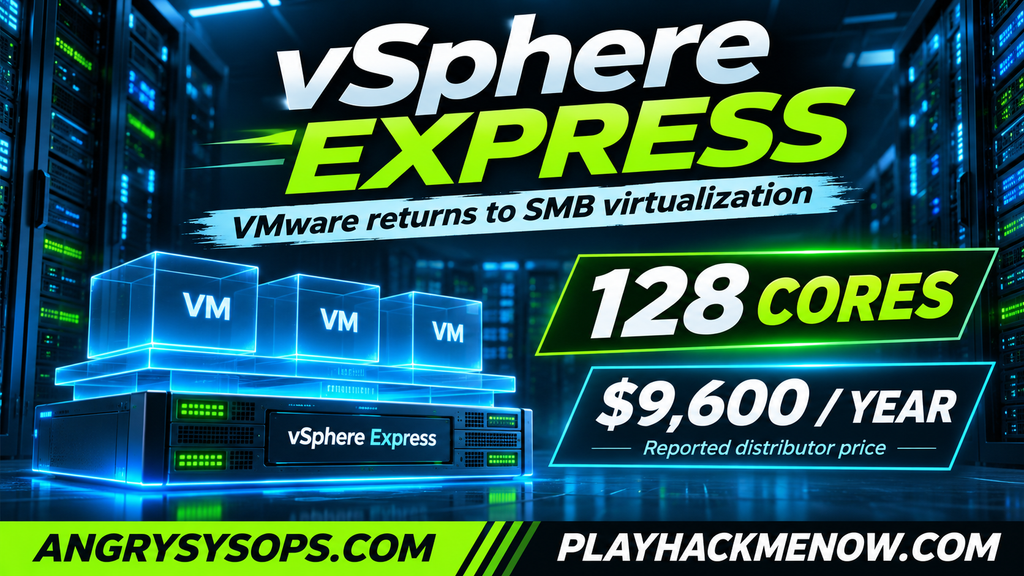
After years of licensing shake-ups, bigger bundles and sysadmins wondering whether their next upgrade would come with a private-cloud-sized bill, VMware has suddenly found room for smaller environments again. On 4 November 2026, Broadcom announced vSphere Express: a vSphere 9-based offering for deployments with up to 128 CPU cores.
On paper, it sounds like exactly what smaller VMware shops have been asking for: familiar virtualization tools without committing to a full VMware Cloud Foundation stack. Then comes the price tag. Distributor TD SYNNEX lists a fixed 128-core package for $9,600 per year. Have only 32 or 64 cores? That does not automatically lower the package price. See TD SYNNEX’s published listing.
So is vSphere Express Broadcom finally listening to the SMB market—or simply a cheaper way to stay inside an increasingly expensive ecosystem? Let’s break down what you actually get, what you don’t, and whether the numbers make sense.
What exactly is vSphere Express?
Think of Express as a smaller vSphere deployment option, not a stripped-down VCF installation. Broadcom says it is available immediately in all regions and intended for customers who need essential compute virtualization without buying an enterprise private-cloud platform.
According to Broadcom’s official announcement, the included capabilities are:
| Feature | Why a sysadmin cares |
|---|---|
| vMotion | Move running VMs between hosts without a planned shutdown. |
| High Availability (HA) | Restart affected VMs on surviving hosts after a host failure, subject to capacity and configuration. |
| vSphere Distributed Switch | Use consistent virtual networking across hosts with centralized switch configuration. |
| vCenter Quick Patch | Reduce disruption during supported vCenter patch operations. Do not confuse this with ESX live patching. |
| TPM 2.0 / vTPM 2.0 | Support hardware and virtual trusted-platform-module use cases. |
TD SYNNEX’s SKU VCF-VSP-EXP also explicitly lists vCenter Standard, ESX and VDS. So we are talking about an actual vSphere environment with the familiar management tools, not a single standalone hypervisor image.
The $9,600 question: how much are you really paying?
Broadcom has not published a universal public list price in its announcement. The $9,600 annual figure comes from TD SYNNEX’s US marketplace page, which advertises one SKU, one price and a one-year term. Your final reseller quote, discounts, taxes and regional terms may differ.
At full use, the mathematics look reasonable on paper: $9,600 ÷ 128 = $75 per core per year. The problem is that it is a fixed package. If your estate is smaller, your effective cost per core increases.
| Physical cores in use | Annual package | Effective $/used core/year |
|---|---|---|
| 32 | $9,600 | $300 |
| 64 | $9,600 | $150 |
| 96 | $9,600 | $100 |
| 128 | $9,600 | $75 |
Illustrative calculation based on the distributor’s $9,600 flat annual package, not a claim that a smaller core count receives a reduced licence. Count billable cores and any per-CPU minimum with your reseller before comparing quotes.
The features you don’t get may matter more
It is tempting to look at the feature list, see vMotion and HA, and declare victory. For a small production cluster, though, some omissions can completely change the design.
C4C Group’s analysis of reseller briefings says Express does not include Distributed Resource Scheduler (DRS), GPU/vGPU support, memory tiering or ESX live patching. These restrictions are reported from channel briefings, not a complete exclusions list published in Broadcom’s launch announcement. Confirm them against your actual SKU and entitlement documentation.
- No DRS (reported): vMotion lets an administrator move a VM; DRS is what automatically balances workloads across hosts. HA is not a replacement for DRS.
- No GPU/vGPU support (reported): This could rule out designs that depend on GPU-accelerated workloads, even if the CPU core count fits.
- Quick Patch is not the same as ESX live patching: Do not assume every patch can be applied without host evacuation or a maintenance window.
- Limited scale and centralization: VMware’s executive told The Register that Express instances are discrete, without a central management layer for multiple instances.
Also, don’t assume that storage, network virtualization and cloud automation products such as vSAN, NSX or VCF Automation are part of this SKU just because Express is based on vSphere 9. Those capabilities are not among the core inclusions Broadcom announced; ask your reseller what is and is not licensed.
The other catch: can existing VMware customers actually buy it?
Broadcom’s launch note confirms immediate worldwide availability, but it does not publish complete customer-eligibility rules. According to C4C’s reporting on reseller briefings, Express is being positioned primarily for new or returning VMware customers, while existing customers may require Broadcom approval. The same briefing-based reporting describes a single fixed package per customer that cannot simply be stacked to scale past 128 cores.
Those points need to be treated as commercial restrictions reported by resellers, not assumed universal policy. Before you plan a renewal or hardware refresh around Express, get the eligibility decision and the orderable configuration confirmed in writing.
Who is vSphere Express actually for?
From an infrastructure engineer’s perspective, this product makes the most sense for a relatively simple, stable environment that already fits within the core ceiling and values VMware continuity more than an extensive feature catalogue.
| Scenario | My assessment |
|---|---|
| Small production cluster, basic VM workloads | Worth pricing, especially if vMotion, HA and distributed switching cover your actual requirements. |
| Existing VMware shop facing an expensive renewal | Potentially interesting, but first confirm eligibility and compare the full renewal costs. |
| DRS-dependent, GPU, VDI or growing estate | Likely a poor match if the reported feature exclusions apply. |
| Tiny environment or home lab | A $9,600 flat annual package is very hard to justify purely as a budget option. |
What I would check before signing a purchase order
If this landed on my desk as a proposed solution for a production environment, I would want answers to these questions before recommending it:
- How many billable cores do we have? Count every host, processor and physical core in scope, and validate minimum-core-per-CPU rules.
- Do we use DRS today? Inventory resource pools, affinity rules, cluster balancing and automation before assuming Express can replace our existing edition.
- Do any workloads need GPU, vGPU or other higher-edition features? Check current and planned VMs, not just the visible headline features.
- Can we actually order this SKU? Get reseller confirmation of regional availability, eligibility and whether it can be used for our existing licence estate.
- What happens when we grow to 129 cores? Confirm the upgrade path, commercial consequences and renewal process in advance.
- Does the three-year cost beat the alternatives? Compare subscription, support, migration effort, hardware and staff time against staying on Standard where available, VVF, VCF and competing platforms.
Angry Admin’s take: welcome back, but the trust problem is real
Let’s give credit where it is due. A modern vSphere 9-based option with vCenter, vMotion, HA and distributed networking is better than forcing every small VMware deployment into a private-cloud bundle it does not need. Broadcom is at least responding to a real market problem.
But for an SMB, $9,600 per year is not automatically cheap, especially when it buys a fixed package instead of exactly the number of cores in the rack. The reported lack of DRS is also more important than it may first appear. And if existing customers need special approval to purchase it, then the licensing conversation is far from over.
There is a broader issue, too: VMware customers make infrastructure decisions for years, not just until the next renewal. A lower-tier SKU is useful, but rebuilding confidence requires predictable terms, clear product boundaries and support that remains consistent over time.
What do you think? Is vSphere Express enough to bring smaller customers back to VMware, or has Broadcom waited too long? Let me know in the comments.
Sources and further reading
- Broadcom / VMware: official portfolio announcement (4 November 2026)
- TD SYNNEX: vSphere Express 128-core marketplace listing
- Ars Technica: VMware releases vSphere Express
- The Register: vendor briefing, distribution and management model
- C4C Group: licensing and feature restrictions reported from reseller briefings
Information checked 6 November 2026. Pricing and eligibility may vary by country, reseller and contract. Confirm commercial and technical requirements before purchase.
AngrySysOps.com — virtualization, infrastructure and the occasional licensing headache.