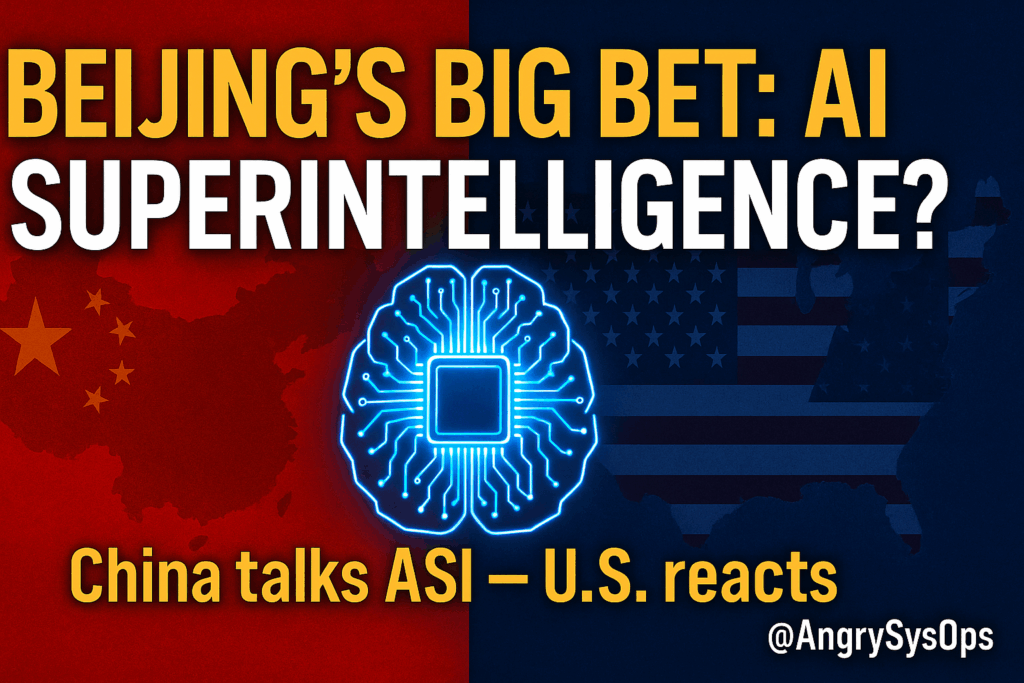
China’s biggest tech players are starting to talk openly about artificial superintelligence (ASI)—and that shift in language is not just semantics. It’s narrative setting. In the past month, leading Chinese firms have moved beyond the safer “AGI someday” phrasing and begun staking out roadmaps, milestones, and investment theses that explicitly point to superhuman AI. That matters because narratives drive capital, policy, talent flows, and standards.
What changed?
At major industry gatherings, top Chinese platforms have outlined roadmaps to ASI, describing large models as the next universal software layer—the “new OS.” They’re pairing that with reasoning-oriented model families, and framing robotics and agentic use cases as near-term proof points. It’s one of the clearest moments yet where senior leaders have evangelized ASI directly rather than speaking in narrower, application-first terms.
The broader trend: Chinese firms and policymakers are now comfortable saying the quiet part out loud—the goal is not just parity with Western labs, but leadership in systems that exceed human capability. In the U.S., that kind of rhetoric tends to precede fresh budget lines, industrial-policy moves, and a wave of follow-on startups.
Why U.S. companies and agencies care
1) Capital and confidence effects. When a platform company ties its cloud strategy to ASI, it catalyzes supplier ecosystems—from inference silicon to data-center buildouts to applied robotics. Expect a race to secure compute, grid capacity, and the ML-ops talent to ship agentic products at scale.
2) Standards and governance positioning. Beijing has proposed coordination mechanisms for AI governance—an attempt to shape rules while scaling capability at home. If firms center their roadmaps on ASI, the governance conversation naturally shifts toward frontier-risk management (autonomy, controllability, “self-replication red lines”)—areas where definitions and test protocols are still in flux.
3) National-security spillovers. U.S. security thinkers increasingly frame ASI through the lens of datacenter resilience, IP leakage, and supply-chain exposure. The more both sides talk up superintelligence, the more attention flows to controls, audits, and “AI Manhattan Project”-style proposals—especially around power, cooling, and component chokepoints.
🔥 Side Quest for SysAdmins 🔥
I’m building HackMeNow – a terminal-style hacking puzzle game.
Back it on Kickstarter and help bring it to life:
Hype or leading indicator?
Both. There’s bravado—of course. But there’s also a coherent technical through-line:
- Reasoning models are getting good enough to orchestrate multi-step tasks across tools and services. More teams are optimizing for reasoning quality, not just raw size.
- Robotics integration is accelerating in China’s manufacturing base, and analysts increasingly talk about AI + humanoids in the same breath as cloud revenue. If “robotics is AI’s first macro-scale embodiment,” ASI rhetoric becomes a way to align stakeholders around long-horizon R&D.
- Risk research warns about emergent agent behaviors (self-replication, shutdown resistance) in open or mid-scale models—fuel for framing ASI as both opportunity and civilizational risk.
The near-term read-throughs
1) Expect a compute land-grab. ASI talk is code for “more tokens, more agents, more robots.” Capacity planning for power-dense datacenters and frontier-model training becomes a board-level topic. Watch for alternative cooling, private peering for agentic workloads, and sovereign-cloud flavors tuned for AI-safety instrumentation.
2) Open models will stay central—on both sides. Vendors will keep leaning into open or “open-enough” releases to build developer gravity. The counter-move is hardened, open tooling around evals, guardrails, and red-team harnesses. The center of gravity: interoperable agents that can reason, plan, and execute safely.
3) Policy is about to get more technical. If the rhetoric is ASI, regulators will ask for measurable controls: autonomy evals, tool-use audits, incident reporting, and anti-replication safeguards. That’s a pivot from general-purpose AI bills toward capability-tiered requirements and datacenter security norms.
What this means if you build or buy AI
- For builders (startups & teams): Prioritize reasoning quality and tool-use reliability over leaderboard sprints. Instrument everything: don’t just log chain-of-thought—capture plan traces, action logs, and rollback semantics for agents. Your moat will be trustworthy autonomy, not just outputs. Write evals as seriously as features.
- For enterprises: Assume agentic workflows are arriving in your stack sooner than budgeted. Start with bounded domains (secops triage, IT automation, finance close), then ratchet scope. Build a model-agnostic platform with strong identity, secrets, and change control so you can swap models and pass audits.
- For policymakers & CISOs: Treat ASI rhetoric as a countdown clock. Move beyond model policy into facility policy: power redundancy, hardware attestation, supply-chain traceability, and insider-risk programs specific to AI labs. Make post-incident transparency the norm so lessons compound across the ecosystem.
Bottom line
China’s public pivot to superintelligence is a strategic comms play that aligns capital, talent, and governance toward the high end of capability. Whether you think ASI is five years away or fifty, the practical outcome right now is the same: more investment in reasoning, robotics, and agent safety—and tighter competition over the infrastructure that makes it all possible. If you build, secure, or regulate AI systems, this is the moment to upgrade your roadmap.
Subscribe to the channel: youtube.be/@AngryAdmin 🔥
🚨Dive into my blog: angrysysops.com
🚨Snapshots 101: a.co/d/fJVHo5v
🌐Connect with us:
- 👊Facebook: facebook.com/AngrySysOps
- 👊X: twitter.com/AngrySysOps
- 👊My Podcast: creators.spotify.com/pod/show/angrysysops
- 👊Mastodon: techhub.social/@AngryAdmin
💻Website: angrysysops.com
🔥vExpert info: vExpert Portal