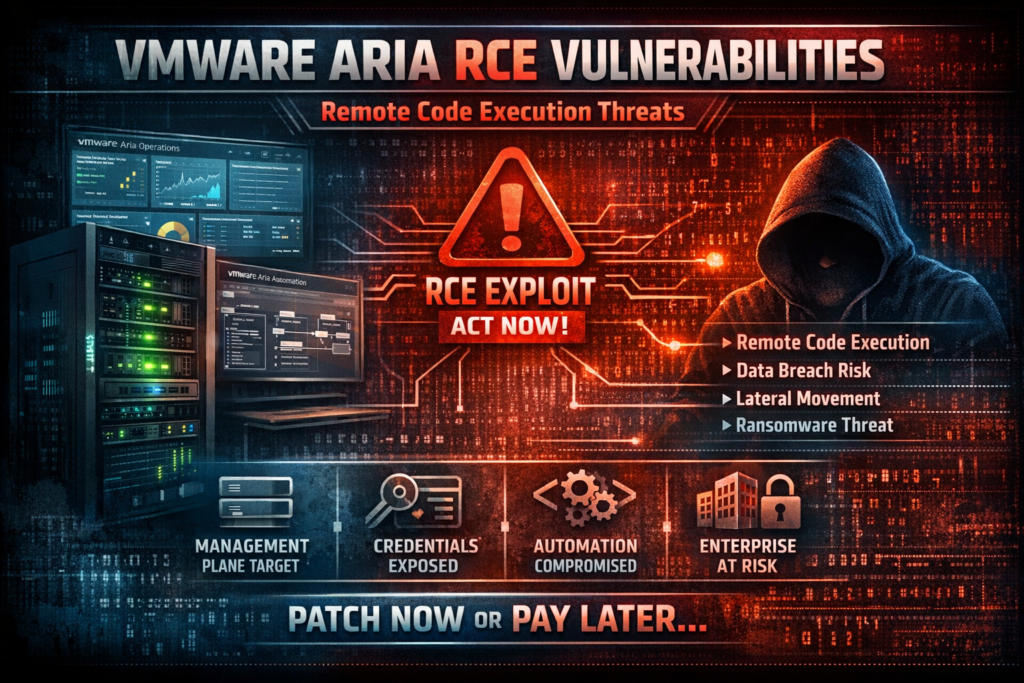
If you’re running VMware Aria Operations, VMware Aria Automation, or any part of the Aria stack in production, stop scrolling.
On February 24, 2026, Broadcom released VMSA-2026-0001, disclosing three vulnerabilities in VMware Aria Operations.
They’re all rated Important.
One of them enables remote code execution.
If Aria Operations is part of your control plane, this is not a “next quarter” patch.
🚀 Follow Me on X – New Account
My previous X account @AngrySysOps was suspended.
I am continuing the same tech, cybersecurity, and engineering discussions under a new handle.
Follow @TheTechWorldPod on X for daily insights, threads, and podcast updates.
The Vulnerabilities (What Actually Matters)
The advisory covers three CVEs:
- CVE-2026-22719 – Command injection (CVSS 8.1)
- CVE-2026-22720 – Stored cross-site scripting (CVSS 8.0)
- CVE-2026-22721 – Privilege escalation (CVSS 6.2)
Let’s break down the operational impact.
CVE-2026-22719 — Command Injection → Potential RCE
This is the one that should get your attention.
An unauthenticated attacker can exploit a command injection vulnerability during support-assisted product migrations. Successful exploitation could allow execution of arbitrary commands.
Translation: if triggered in the right context, you’re looking at remote code execution in a management platform.
And Aria is not some isolated monitoring box. It typically has visibility and integration into:
- vCenter
- Automation pipelines
- Cloud Foundation stacks
- Telco environments
That’s control-plane territory.
CVE-2026-22720 — Stored XSS via Custom Benchmarks
This issue allows a privileged user to create custom benchmarks and inject scripts that execute administrative actions.
While this requires privileges, insider abuse or compromised accounts turn this into a serious risk. XSS in management interfaces is rarely “just XSS” in enterprise platforms.
🚀 Follow Me on X – New Account
My previous X account @AngrySysOps was suspended.
I am continuing the same tech, cybersecurity, and engineering discussions under a new handle.
Follow @TheTechWorldPod on X for daily insights, threads, and podcast updates.
CVE-2026-22721 — Privilege Escalation from vCenter Access
Users with vCenter access can escalate to administrator-level privileges inside Aria Operations.
In environments where vCenter access is broadly distributed, this is a clear lateral privilege boundary failure.
Affected Products (It’s Wider Than You Think)
Aria Operations isn’t deployed in isolation. It’s embedded across multiple stacks:
- VMware Cloud Foundation
- VMware Telco Cloud Platform
- VMware Telco Cloud Infrastructure
Impacted versions include:
- Aria Operations 8.x
- Cloud Foundation 9.x / 5.x / 4.x bundles
- Telco Cloud Platform 5.x / 4.x
- Telco Cloud Infrastructure 3.x / 2.x
If you run Aria as part of any of these stacks, you’re potentially exposed.
Fixes and Workarounds
Patches are available.
Examples include:
- Aria Operations 8.18.6
- Cloud Foundation 9.0.2.0
- Additional updates referenced in KB92148 and KB428241 depending on product bundle
There is a workaround for CVE-2026-22719 (via KB430349).
There are no workarounds for the other two vulnerabilities.
That should influence your prioritization model.
Why This Is Operationally Dangerous
The most concerning part is the migration-related RCE vector.
Migration workflows are often:
- High-privilege
- Less frequently tested
- Performed under time pressure
That combination is exactly what attackers look for.
If exploitation occurs during migration activity, you’re not just dealing with one compromised VM. You’re potentially compromising:
- Monitoring visibility
- Automation frameworks
- Cloud operations
- Credential stores
And once management plane trust is broken, recovery is expensive.
What You Should Do Now
- Inventory your Aria deployments
- Standalone?
- Embedded in Cloud Foundation?
- Telco stack?
- Match versions against the advisory matrix
- Apply updates immediately
- If patching must be staged:
- Implement the available workaround for CVE-2026-22719
- Restrict access to migration workflows
- Audit privileged access paths
Credit Where It’s Due
The vulnerabilities were responsibly reported by:
- Tobias Anders (Deutsche Telekom Security)
- Sven Nobis
- Lorin Lehawany (ERNW)
This is what coordinated disclosure is supposed to look like.
Final Thought
We’ve entered an era where the management layer is the primary target.
Aria Operations is part of the control fabric of modern VMware environments. When vulnerabilities land there, they carry disproportionate impact.
If you’re a platform engineer, this isn’t noise.
It’s action.
Patch it.
🚀 Follow Me on X – New Account
My previous X account @AngrySysOps was suspended.
I am continuing the same tech, cybersecurity, and engineering discussions under a new handle.
Follow @TheTechWorldPod on X for daily insights, threads, and podcast updates.